


In a world that demands fresh strawberries in February and life-saving vaccines delivered across continents, cold storage is the unsung hero of the global supply chain. It’s not just a big fridge; it’s a sophisticated feat of engineering designed to pause time for perishable goods.
Whether you’re a business owner looking into logistics or just curious about how your steak stays safe, here is everything you need to know about cold storage systems.
What Exactly is a Cold Storage System?
At its core, a cold storage system is a temperature-controlled environment used to preserve goods that would otherwise spoil at room temperature. By slowing down the chemical changes and biological decay (bacteria growth) in products, these systems extend shelf life significantly.
The Architecture of Cooling
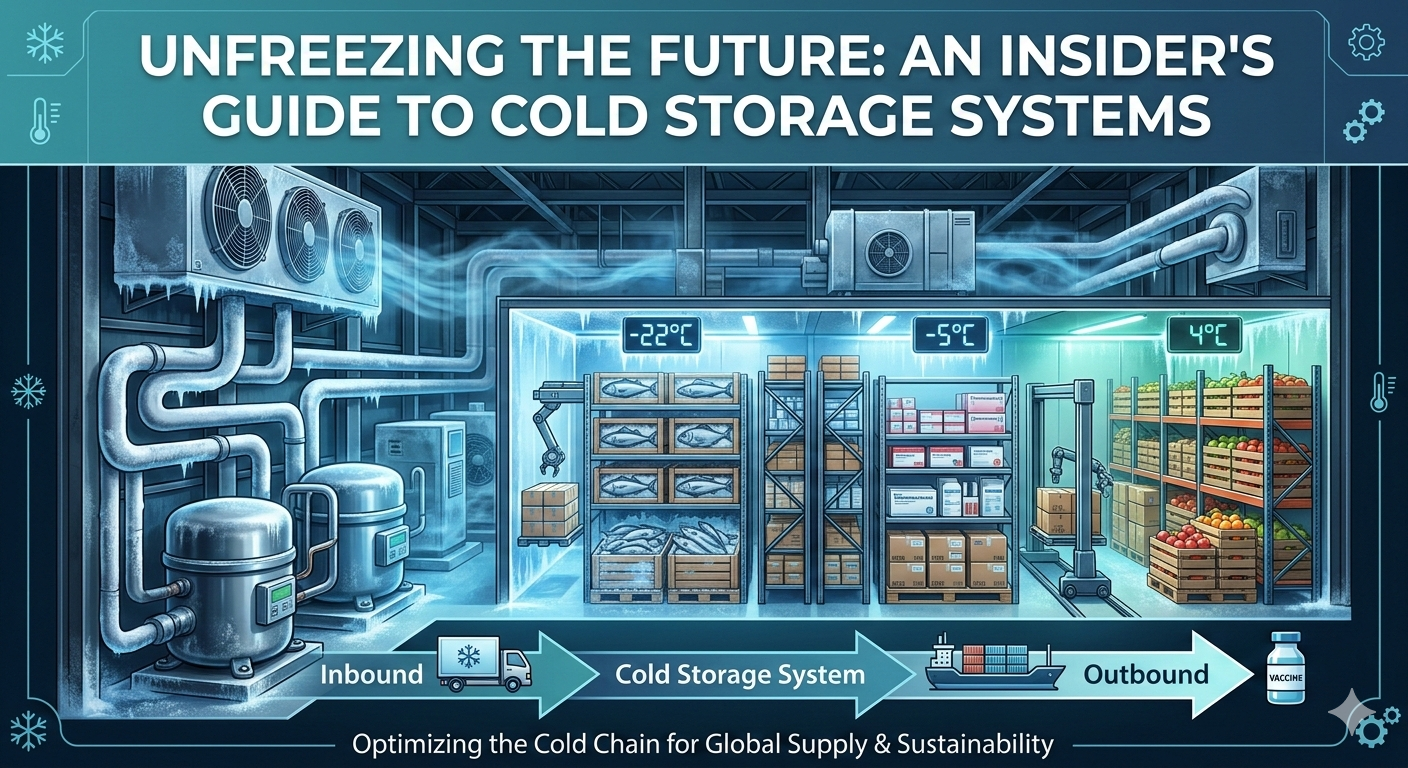
A functional cold storage facility isn’t just about the “AC.” It relies on several integrated components:
- The Refrigeration Unit: The heart of the system, comprising compressors, condensers, and evaporators.
- Insulated Panels: High-density polyurethane or mineral wool panels that prevent thermal leakage.
- Airflow Systems: Fans and ducts that ensure “hot spots” don’t form in corners.
- Monitoring Sensors: IoT-enabled devices that track temperature and humidity in real-time.
Types of Cold Storage
Not all “cold” is created equal. Depending on the product, the system is tuned to specific parameters:
| Type | Temperature Range | Common Uses |
| Chilled/Cold Rooms | 0°C to 15°C | Fruits, vegetables, dairy, and floral products. |
| Freezer Rooms | -18°C to -25°C | Frozen meats, seafood, and pre-cooked meals. |
| Blast Freezers | -30°C to -50°C | Rapidly freezing fresh items to lock in nutrients and texture. |
| Deep Freeze | Below -60°C | Specialized pharmaceuticals, vaccines, and biological samples. |
Why Cold Storage Matters (Beyond the Grocery Store)
- Reducing Food Waste: Roughly one-third of all food produced globally is lost or wasted. Cold storage is the primary weapon against this statistic, ensuring produce makes it from the farm to the fork.
- Pharmaceutical Integrity: Many modern medicines are “biologics,” meaning they are incredibly sensitive to heat. Without a “Cold Chain,” global vaccination efforts would be impossible.
- Economic Stability: It allows producers to store surplus goods when prices are low and release them when demand peaks, stabilizing the market.
The Future: Smart Cold Storage
The industry is currently undergoing a “green” and “smart” revolution.
- Automation: Modern facilities use Automated Storage and Retrieval Systems (ASRS) to minimize the time doors stay open, saving massive amounts of energy.
- Sustainability: New systems are moving away from harmful hydrofluorocarbons (HFCs) toward natural refrigerants like $CO_2$ and Ammonia ($NH_3$).
- AI Integration: Predictive algorithms can now forecast when a compressor might fail before it actually happens, preventing catastrophic product loss.
Final Thoughts
Cold storage is the backbone of modern convenience and safety. As technology evolves, these systems are becoming more energy-efficient and precise, ensuring that the world stays fed and healthy—one degree at a time.



Leave a Reply