

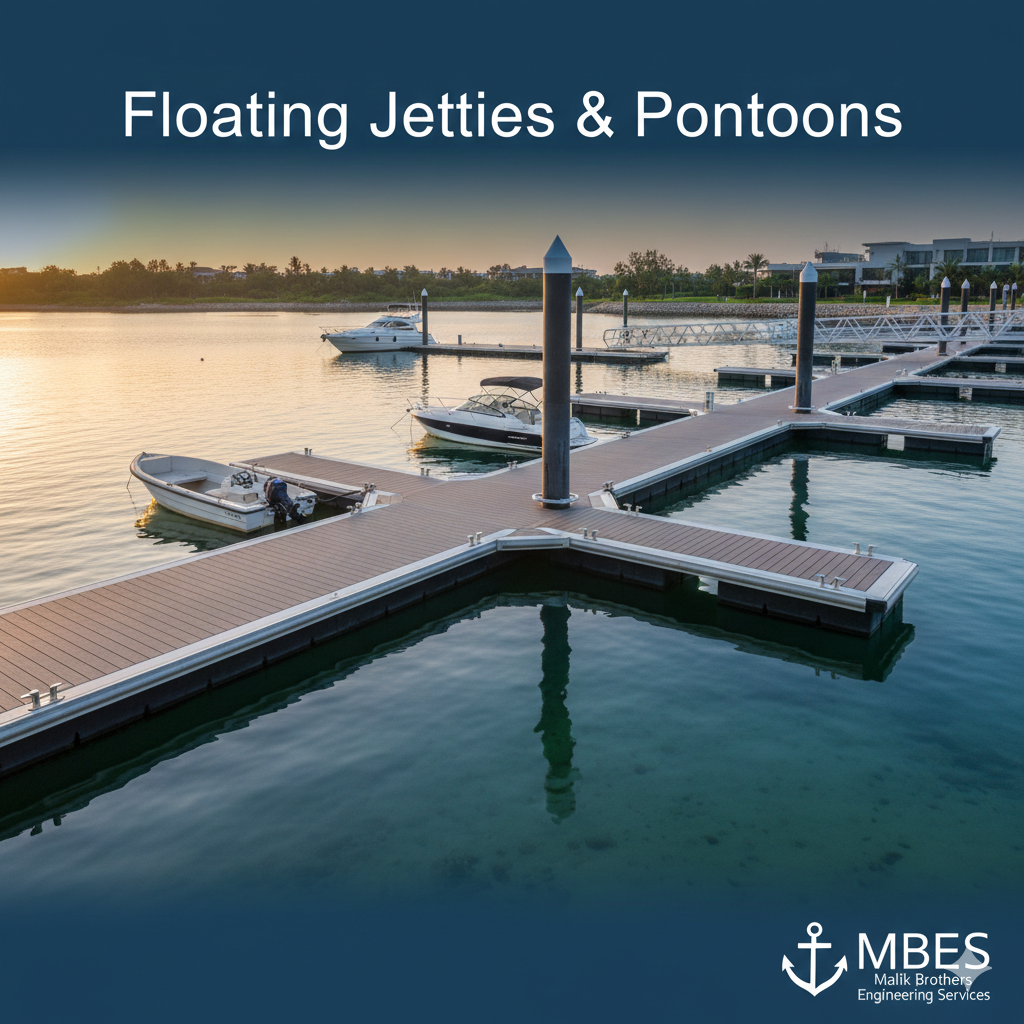
In the world of marine infrastructure, the challenge has always been the same: how do you bridge the gap between solid land and the ever-shifting surface of the water? For decades, the answer was fixed piers. But as coastal development evolves and environmental awareness grows, Floating Jetties and Pontoons have emerged as the superior, versatile alternative.
At Malik Brothers Engineering Services (MBES), we specialize in delivering marine solutions that balance structural integrity with the fluid nature of the sea. Here is everything you need to know about these floating marvels.
What are Floating Jetties & Pontoons?
While the terms are often used interchangeably, there is a subtle difference:
- Pontoons: These are the buoyant structures (the “floats”) that provide the lifting force.
- Floating Jetties: This refers to the entire walkway system supported by pontoons, often connected to the shore via a hinged gangway.
Unlike fixed jetties, which are built on permanent piles driven into the seabed, floating systems “ride” the water.
Why Choose Floating Over Fixed?
1. Adaptation to Tidal Changes
In regions with significant tidal swings, a fixed jetty can become dangerously high above the water at low tide or submerged at high tide. Floating systems maintain a constant freeboard (the distance between the water and the deck), ensuring safe boarding for vessels at all times.
2. Environmental Preservation
Traditional construction often requires heavy pile-driving, which disrupts seabed ecosystems and siltation patterns. Floating pontoons have a minimal footprint. They require fewer piles (used only for anchoring) and allow for natural water flow and light penetration beneath the structure.
3. Rapid Deployment and Scalability
Floating systems are often modular. They can be manufactured off-site, towed to the location, and assembled in a fraction of the time it takes to pour concrete or drive dozens of piles. If your marina needs to expand, you simply add more modules.
4. Durability in Harsh Conditions
Modern floating jetties are designed to absorb the energy of waves. While a fixed pier resists wave force (which can lead to structural fatigue), a floating pontoon moves with the energy, often resulting in a longer lifespan in choppy waters.
Material Matters: What Goes Into a Pontoon?
To survive the corrosive “Gold Coast” or industrial marine environments, material choice is critical:
- Concrete Pontoons: Heavy, incredibly stable, and virtually maintenance-free. These are the “heavyweights” used for commercial ship berthing.
- Aluminum/Steel Frames: Lightweight and high-strength, often used for private jetties and rowing clubs.
- HDPE (High-Density Polyethylene): Modular “cubes” that are easy to install, chemical-resistant, and perfect for temporary walkways or jet ski docks.
Engineering the Connection
A floating jetty is only as good as its Mooring System. At MBES, we evaluate site-specific data—including wind loads, current speeds, and wave heights—to determine the best anchoring method:
- Piles: Steel or concrete poles that keep the jetty in place horizontally while allowing vertical movement.
- Seaflex or Chain Mooring: Using weighted anchors on the seabed for areas where piles aren’t feasible.
Conclusion
Whether you are developing a luxury marina, a commercial fishing hub, or a private waterfront property, floating jetties offer a future-proof, eco-friendly, and cost-effective solution.


Leave a Reply